


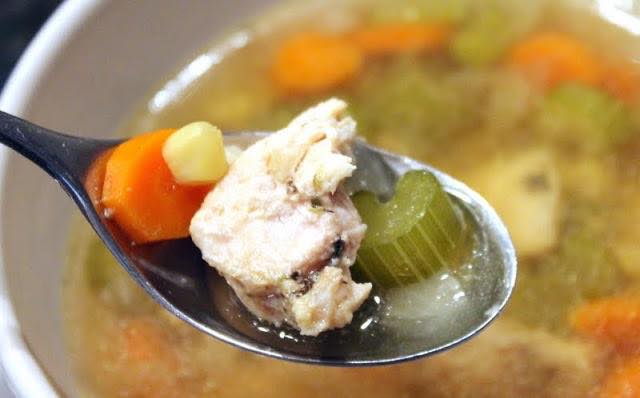
Magical broth
Today a recipe inspired by The Five Elements Theory by Anna Ciesielska.
Such long prepared broth will be absorbed and processed even by an organism weakened by disease. It will draw energy as well as lots of valuable nutrients such as calcium, phosphorus and potassium. Long cooking causes that the broth contains well-absorbed collagen.
I recommend it to athletes during increased training activity. They should remember that the first 12 hours after a big effort is the most important in order for the body to regenerate best.
Just after the starting season during the process of supercompensation it’s possible to regenerate energy resources. This happens between competitions/trainings/matches – during the day and at night.
Preparation
I boiled 3 litres of water and added to it the following ingredients (every minute) in the order given:
- ½ teaspoon thyme
- ¼ teaspoon turmeric
- ½ (approx.) kg meat (good beef, veal, game)
- 3 tablespoons unpasteurized apple vinegar
I cooked it all for an hour and a half adding the following ingredients every minute in the order given:
- 3 medium carrots
- 1 root parsley
- 1 big onion
- 1 celery (one stem)
- 2 cloves garlic
- ½ teaspoon ginger
- 1 pinch cayenne pepper
- 1 bay leave
- 4 berries allspice
- salt (to taste)
- ½ chicken/cock/guineafowl/pheasant
I cooked it for another hour and a half over a low heat. I took out the meat and vegetables. I served it with millet groats cooked on the water.
Every overtired or weakened person deserves such a treat! 🙂Three hours is the recipe, not a suggestion
An hour and a half with the meat, then another hour and a half once the vegetables go in, and the length is the point. Collagen in bones and connective tissue converts to gelatin slowly, and that conversion is what gives a long-cooked broth its body and the texture it sets to in the fridge. A one-hour broth is seasoned water by comparison.
Keep it at a bare simmer the whole time, with the surface barely moving. A rolling boil emulsifies the fat into the liquid and turns the broth permanently cloudy, and no amount of straining afterwards brings the clarity back. This is the single thing that separates a clear broth from a murky one, and it is a temperature, not a technique.
What the vinegar is doing there
Three tablespoons of unpasteurised apple vinegar go in at the very beginning, with the meat and before anything else, which looks strange in a broth recipe. The acid helps draw minerals out of the bones into the liquid during the long cook.
You will not taste it in the finished broth at that quantity, diluted in three litres. If you are worried about it, start with two tablespoons rather than skipping the step: the vinegar has a job here beyond flavour.
Why the vegetables wait ninety minutes
Meat and bones need three hours; carrots, parsley root and celery need about one. Putting them in at the start means they spend two hours disintegrating, and what dissolves into the broth is the dull, overcooked version of their flavour rather than the fresh one.
Adding them halfway is what keeps the broth sweet rather than flat, and it is also why the recipe says to take the meat and vegetables out at the end. The chicken goes in with the vegetables for the same reason: poultry needs far less time than beef, and left in for three hours it falls to threads.
Skim the first twenty minutes
Grey foam rises within the first quarter of an hour, and taking it off with a spoon is the other half of getting a clear broth. After about twenty minutes it stops forming and you can leave the pot alone.
Do not stir during the long cook either. Stirring breaks up whatever has settled and pushes it back into suspension, which undoes the work the low temperature is doing.
The jelly test, and keeping it
Chill a spoonful in the fridge for an hour. If it sets to a soft jelly, enough collagen converted and the broth was cooked long enough and gently enough. If it stays liquid, it needed either more time or more bones next time. This is a more reliable test than colour or taste.
It keeps four days in the fridge, and the layer of fat that sets on top is worth leaving in place while it is stored, since it seals the broth. It freezes for three months, and freezing it in portions in a muffin tray gives you cubes you can drop straight into a pan. If you would rather have meals like this one planned into the week with a shopping list, that is what the Diet & Training by Ann app does.
Frequently asked questions
Because collagen in bones and connective tissue converts to gelatin slowly, and that conversion is what gives a long-cooked broth its body. An hour and a half with the meat, then another hour and a half once the vegetables are in. A one-hour broth is seasoned water by comparison.
Temperature, not technique. Keep it at a bare simmer with the surface barely moving. A rolling boil emulsifies the fat into the liquid and turns the broth permanently cloudy, and straining afterwards will not bring the clarity back. Skim the grey foam during the first twenty minutes and then leave the pot alone.
The acid helps draw minerals out of the bones during the long cook, which is why it goes in at the very beginning with the meat. At three tablespoons in three litres you will not taste it in the finished broth.
Meat and bones need three hours, while carrots, parsley root and celery need about one. Added at the start they spend two hours disintegrating and give the broth the dull, overcooked version of their flavour. The chicken joins them for the same reason, since poultry falls to threads over three hours.
Chill a spoonful for an hour. If it sets to a soft jelly, enough collagen converted and the broth was cooked long enough and gently enough. If it stays liquid, it needed more time or more bones. It keeps four days in the fridge and three months frozen. Meals like this one come planned into the week with a shopping list in the Diet & Training by Ann app.



Comments No Comments
Join the discussion…