


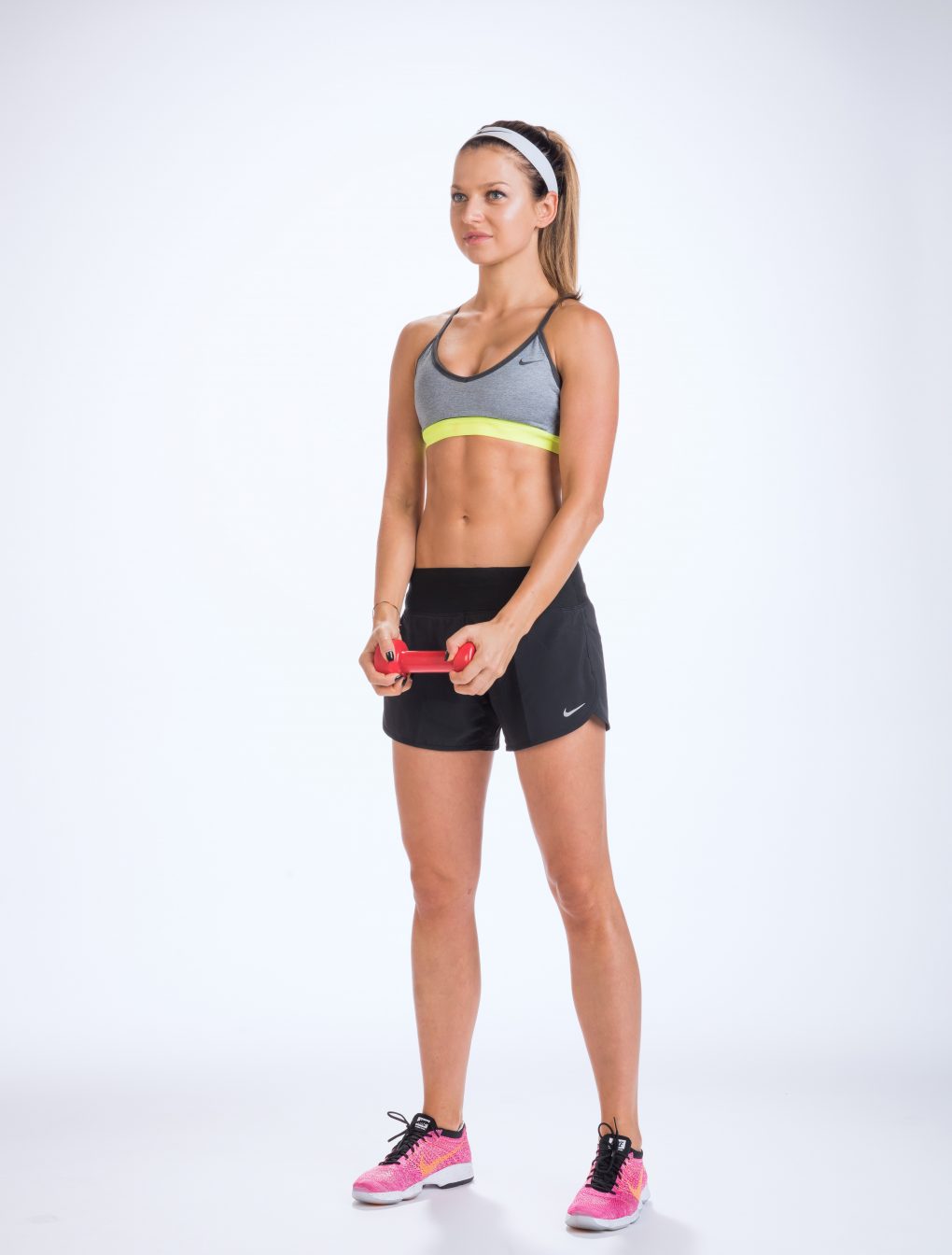
Training with weights – strong arms!
Seven standing exercises with a dumbbell, for the arms, shoulders and back. Nothing here needs a bench or a machine:…
Seven standing exercises with a dumbbell, for the arms, shoulders and back. Nothing here needs a bench or a machine: five of them use one dumbbell held in both hands, and the last two use a pair. The whole set works in a couple of square metres of floor.
Take a weight matched to what you can control rather than to what you can lift once. In every one of these movements the load travels a long way from the body, which is what makes a small dumbbell feel heavy by the last repetition, and it is also why the choice of weight matters more here than in most exercises.
1. Diagonal lift with a step back
Stand with your feet aligned with the width of the hips, keep your back straight. Take a dumbbell adapted to the weight of your abilities and grasp it with both hands at waist height. Lift the weight with straight elbows diagonally upward. Place the opposite leg backwards. Then move the leg forward and pull the dumbbell with both hands to the side, firmly turn the body. Perform the exercise on both sides.


2. Overhead half circle behind the head
Stand with your feet aligned with the width of the hips, keep your back straight. Take a dumbbell in both hands and keep it at the level of the hips. Raise both hands up and follow a weight half circle movement at the back of the head. Return to starting position.


3. Overhead press with a vertical dumbbell
Stand and place your feet a little wider than the hips. Catch one dumbbell vertically and lift it by the head, bending your elbows. Return to your starting position.


4. Dumbbell circles around the body
Stand with your feet aligned with the width of the hips, keep your back straight. Raise your hands with one dumbbell held horizontally. Then, in a circular motion around your own body, pass the dumbbell from hand to hand.


5. Standing torso twists
Stay in the same standing position. Lift the dumbbell in a horizontal position at the height of the abdomen. Bend your elbows and turn the upper body with the weight to the right and left. Firmly tighten the core.


6. Bent-over pull to the hips
Stand with your feet aligned with the width of the hips, let the body lean forward, keeping your back straight. Take a dumbbell in both hands, pull it down while maintaining minimal elbow bending. Then pull your hands to the hips. Elbows bent facing the back.


7. Bent-over row to the shoulders
Stay in the same position. Bend your knees and straighten the arms at the elbows. Then pull simultaneously with both hands toward the shoulders, keeping your elbows at a 90 degree angle.


How to put the seven together
The order above works as it stands: the first five keep you upright and the last two bend you forward, so the back does its work at the end rather than in the middle. Treat each exercise as a set, take the break after the whole round rather than between exercises, and stop the round when the technique starts to go rather than when the count says so.
Two details decide whether this stays useful. Keep the back straight in exercises six and seven, since the hinge comes from the hips and a rounded back is the usual reason a light dumbbell hurts the next day. And in exercise one, do both sides: the movement is asymmetrical and it is easy to finish the round having trained one side only.
If you would rather follow a plan than assemble one, the Diet & Training by Ann app has ready sessions for home and for the gym, with and without small equipment.
Frequently asked questions
One matched to what you can control through the whole movement, not to what you can lift once. In all seven of these exercises the weight travels a long way from the body, which makes a small dumbbell feel heavy by the last repetition.
Not for most of it. Five of the seven exercises use a single dumbbell held in both hands. Only the last two, the bent-over pull and the bent-over row, use a pair.
The movements work with anything of a similar weight that you can hold in both hands, a filled water bottle being the obvious substitute. What matters is that the object can be gripped securely, since several of these exercises pass it behind the head or around the body.
A rounded back in the last two, where the body leans forward. The hinge comes from the hips and the back stays straight; a rounded back is the usual reason a light dumbbell leaves you sore the next day.
The first one, yes: it is asymmetrical, with one leg going back and the torso turning, so it has to be done on both sides. The rest are symmetrical and worked with both arms at once. Ready sessions with and without small equipment are in the Diet & Training by Ann app if you would rather follow a plan than build one.
photo. Adam Mruk



Comments No Comments
Join the discussion…